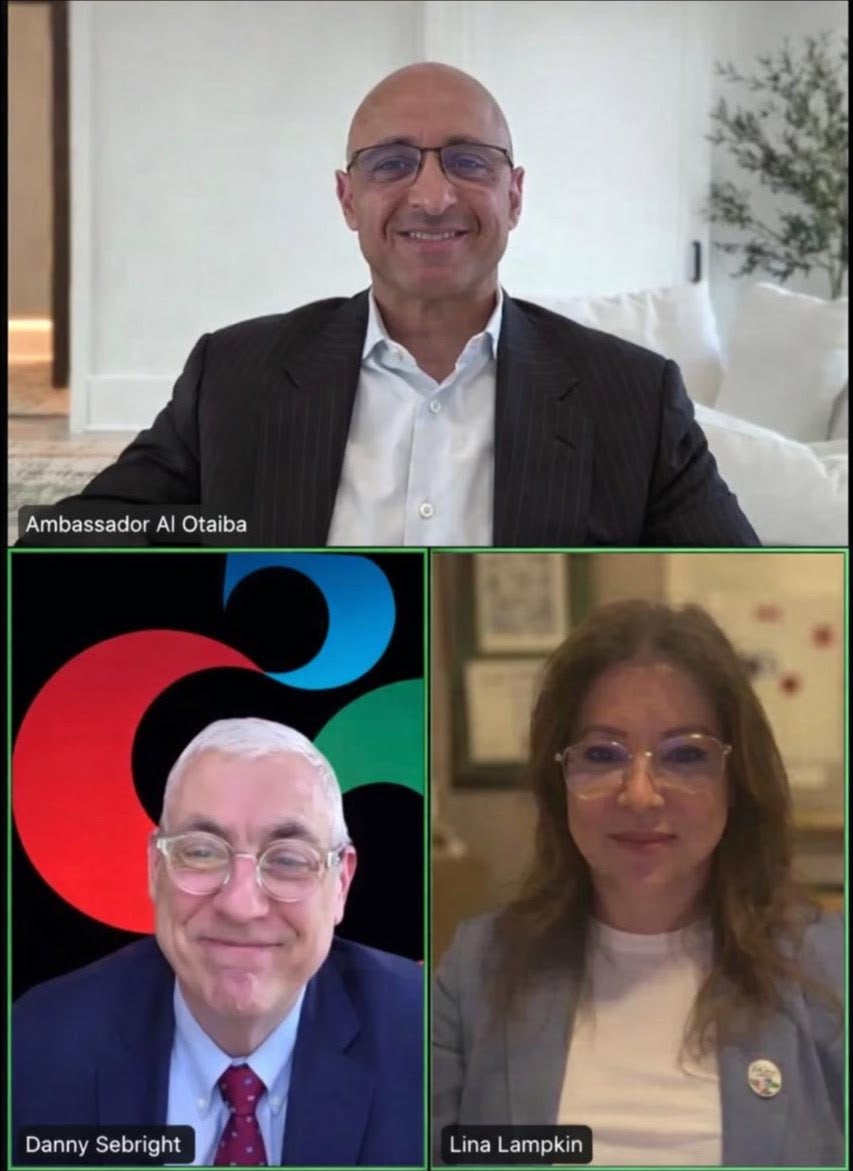
(Bottom from L to R) President of the U.S.-U.A.E. Business Council Danny Sebright; Chairwoman of AmCham Abu Dhabi Lina Lampkin.
“The U.A.E. will come out of this stronger. We will be a stronger partner globally, our vision will not change, and our diversification will not change. Our partners that stuck with us will see stronger commitments from the U.A.E.” – H.E. Ambassador Yousef Al Otaiba.
The U.S.-U.A.E. Business Council, in partnership with AmCham Abu Dhabi, convened a virtual briefing of over 600 participants with U.A.E. Ambassador to the U.A.E. H.E. Yousef Al Otaiba on 31 March 2026.
Bottom Line:
- The U.A.E. is signaling continuity, confidence, and long-term commitments to both economic models and global partnerships.
- H.E. Ambassador Al Otaiba underscored that the U.A.E. will “come out of this stronger” and the U.A.E. will remember those who stand with it now.
This discussion, on the one-month anniversary of the current conflict, provided attendees the opportunity to hear from Ambassador Al Otaiba on current events in the U.A.E. and their implications for business, as detailed in a letter from H.E. Ambassador Al Otaiba shared with partners, as well as his recent Wall Street Journal Op-ed.
War at One Month:
- One month into the U.S.-Israeli war with Iran, the U.A.E. is demonstrating resolve and resilience—while reinforcing its role as a stable, forward-looking economic and security partner.
- The U.A.E. has faced over 2,400 missile and drone attacks in 31 days, nearly 40% of everything launched by Iran, with U.A.E. defense forces intercepting well over 90%.
- U.A.E. leadership is applying a proven playbook from past crises (2008 financial crisis, COVID-19): assess vulnerabilities, address root causes, and emerge stronger.
- “The U.A.E. is an argument that Iran cannot win.” The U.A.E. is an open, modern, and globally integrated economy—in contrast to Iran’s model. This differentiation is a key reason the U.A.E. is being targeted.
- The U.A.E.’s utmost priority is opening the Strait of Hormuz, and it is willing to be part of the solution.
- “We cannot go back to the world of pre-February 28th.” The U.A.E.’s diplomatic conditions for achieving a lasting resolution of peace center around Iran pledging and committing to:
- Cease nuclear enrichment.
- Cease missile and drone strikes.
- Cease proxy support.
- Cease the disruption of global shipping lanes such as the Strait of Hormuz.
U.S.-U.A.E. Bilateral Business Resiliency and Private Sector Confidence:
- The U.A.E. reaffirmed its $1.4 trillion 10-year investment commitment in the U.S.
- The AI Acceleration Partnership and strategic initiatives such as Pax Silica continue to advance with no slowdown despite the conflict – it is “business as usual” on these fronts.
- The U.A.E.’s post-war priorities and areas of enhanced cooperation will focus on strengthening its air and missile defense systems, expanding local manufacturing and supply chain resilience, and enhancing its energy export diversification.
- No major U.S. company has reconsidered its commitment to the U.A.E., and CEOs and major investors in global brands are doubling down on commitments to maintain a presence in the U.A.E.
Concluding Thought:
- “I’ve watched the U.A.E. encounter difficult situations, and I’ve seen the country be guided through troubling times. What people who live in the U.A.E. benefit from is a steady hand guiding the country through the turmoil.” – H.E. Ambassador Al Otaiba
To learn more about this event and the U.S.-U.A.E. Business Council’s programming, please contact Mr. Adam Karadsheh at akaradsheh@usuaebusiness.org.