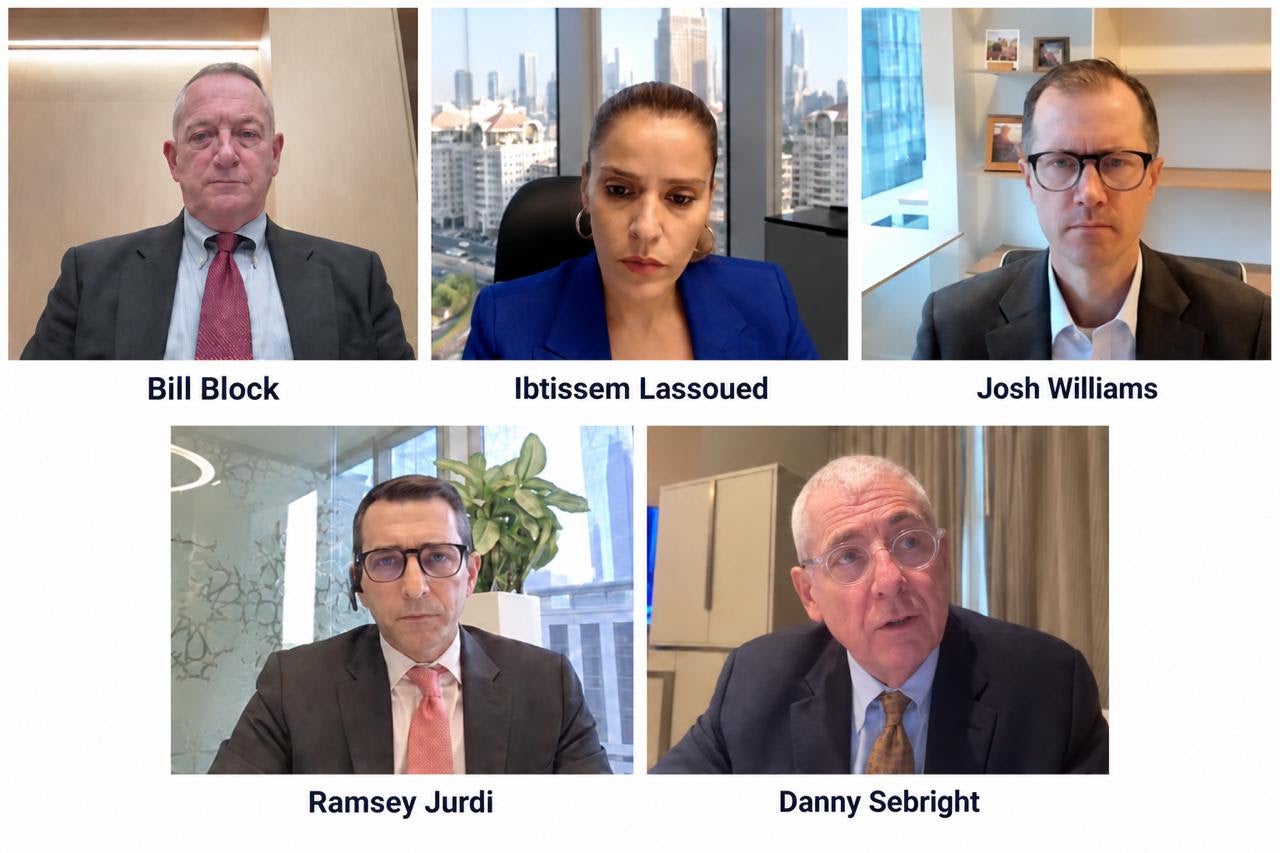
(Bottom Row: L to R): Ramsey Jurdi, Partner, DLA Piper; Danny Sebright, President, U.S.-U.A.E. Business Council
“The goal of Operation Economic Outcast is the complete financial isolation of Iran…As Secretary Bessent has said himself, we are no longer managing the threat from Iran, we are eliminating it.”
– U.S. Treasury Attaché Bill Block
The U.S.-U.A.E. Business Council convened a virtual briefing on Wednesday, September 23, examining the evolving U.S. sanctions landscape related to Iran and the implications for U.S. and U.A.E. companies operating in the region.
Panelists provided insights on U.S. Treasury Secretary Scott Bessent’s launch of Operation Economic Outcast and the newly signed Lindsey O. Graham Sanctioning Russia and Iran Act of 2026. They urged companies to invest the resources necessary to strengthen their internal compliance culture through comprehensive program reviews and operational training, screen counterparties before every transaction, and deepen beneficial ownership and logistics due diligence to mitigate secondary sanctions risks. All panelists underscored that these should be top priorities for companies operating in this environment and that future enforcement actions will only become more extreme and comprehensive.
Panelists included:
- Bill Block, Treasury Attaché, U.S. Embassy in Abu Dhabi
- Ibtissem Lassoued, Partner, Head of White-Collar Crime Advisory, Compliance, Investigations & International Cooperation, Al Tamimi & Company
- Joshua Williams, Partner, Covington & Burling LLP
- Ramsey Jurdi, Partner, DLA Piper
Why it matters
Sanctions compliance is increasingly no longer a static risk area. As the U.S. shifts to aggressive enforcement targeting third-country actors, businesses face severe secondary sanctions risks and supply-chain disruption. Because the U.A.E. serves as a primary regional trade and financial hub, local and international firms must shift internal cultures away from “check-the-box” compliance to mitigate secondary exposure across shipping, technology, aviation, and financial flows.
What was discussed
The discussion focused on key policy and commercial developments shaping the U.S.-U.A.E. sanctions landscape:
- Operation Economic Outcast & Zero Tolerance: U.S. Treasury Attaché Bill Block detailed the rollout of Operation Economic Outcast, emphasizing expanded sectoral sanctions across aviation, tech, maritime, gold, and digital assets. Treasury is enforcing a zero-tolerance policy against violations and actively targeting third-country facilitators.
- New Statutory Authorities: Speakers analyzed the newly enacted Lindsey O. Graham Sanctioning Russia and Iran Act of 2026, which extends the Iran Sanctions Act through 2031 and separately expands sanctions and tariff authorities targeting Russia and certain countries purchasing Russian energy or facilitating Russian oil sanctions evasion.
- Red Flags & Local U.A.E. Enforcement: Ibtissem Lassoued detailed the U.A.E.’s stringent local enforcement framework. Lassoued highlighted potential red flags warranting due diligence, including KYC inconsistencies, unusual transshipment routes, opaque corporate structures, and suspicious digital asset activity (e.g., privacy coins, mixing services, and high-volume stablecoin purchases). She cited the Central Bank of the U.A.E.’s barring of Iran’s Bank Melli from operating in the country as a prime example.
- Practical Risk Mitigation: Panelists advised firms to audit logistics partners, conduct rigorous UBO checks, and invest heavily in continuous staff training. Bill Block cautioned that touchpoints involving targeted sectors in Iran are categorically sanctionable, urging businesses to err on the side of caution and refrain from uncertain transactions.
Primary Compliance Recommendations & Action Items:
- Drive a top-down compliance culture shift: Operating leadership across U.S. and U.A.E. entities should immediately initiate a comprehensive review of compliance programs. Organizations must mandate operational training across freight, logistics, and finance teams to mitigate secondary sanctions risks and adapt to a zero-tolerance environment.
- Screen continuously across every transaction: Transition immediately from one-time onboarding checks to mandatory counterparty screening prior to every transaction to account for rapid list updates.
- Conduct due diligence on ultimate beneficial owners (UBOs): Move beyond standard corporate registries and basic list checks to audit shadow fleet risks, front companies, and downstream logistics touchpoints.
For more information about the U.S.-U.A.E. Business Council’s programming, please contact Ms. Savannah Wallace at swallace@usuaebusiness.org.