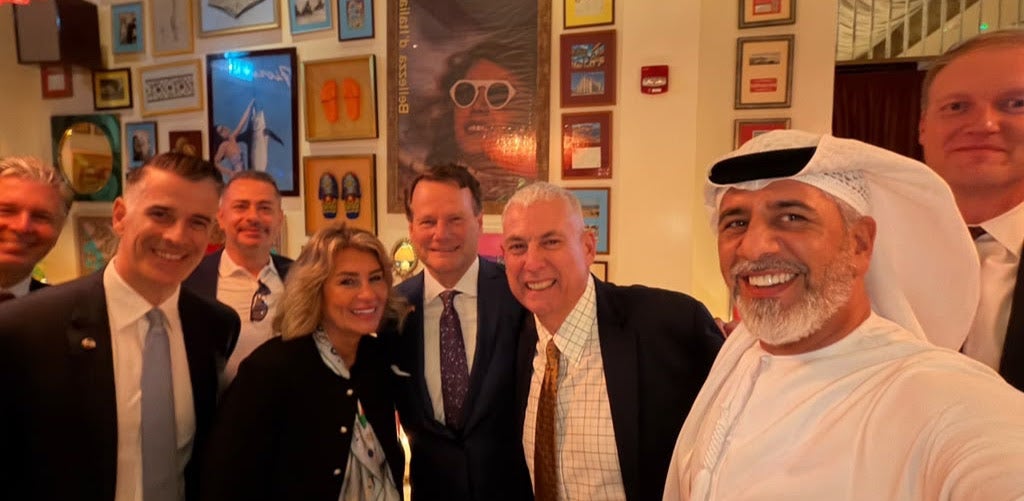
“The U.A.E. is an incredibly close partner to the U.S. in pursuing key regional commercial, trade, and investment objectives. Whether through its strength as an export market for U.S. goods and services, a partner in deploying capital and investment, or the sizable FDI it commits to key U.S. verticals at home, the U.A.E. and the U.S. are more aligned than ever before.” –Deputy Assistant Secretary Mark Mitchell
On Thursday, October 15, 2026, the U.S.-U.A.E. Business Council hosted Mark Mitchell, Deputy Assistant Secretary for the Middle East and Africa at the U.S. Department of Commerce, for a private dinner with key member companies at the Ritz-Carlton, Dubai International Financial Centre.
The gathering brought together senior executives from leading American companies and representatives of the U.S. Mission to discuss the U.A.E.’s recent A:5 designation, expanding opportunities for American businesses, and the resilience of the bilateral commercial partnership amid regional challenges.
U.A.E.’s A:5 Designation and Expanded Technology Cooperation
- On July 10, 2026, the U.S. Department of Commerce’s Bureau of Industry and Security (BIS) announced the U.A.E.’s reclassification as an Export Administration Regulations (EAR) Country Group A:5 destination, removing the country from Groups D:3 and D:4.
- The designation expands eligibility for License Exception Strategic Trade Authorization (STA), allowing qualifying exports, reexports, and in-country transfers of certain controlled technologies without individual export licenses, subject to applicable conditions and compliance requirements.
- The changes benefit private companies by reducing licensing burdens, improving regulatory predictability, and facilitating access to certain advanced technologies, including AI chips and servers, for approved entities.
- U.A.E. companies G42 and Core42, alongside U.S. technology companies including Amazon, Microsoft, Google, Oracle, and others, were identified as beneficiaries of expanded license-free access to advanced computing items.
- The designation is expected to accelerate bilateral cooperation in artificial intelligence, advanced manufacturing, aerospace, energy, and other strategic sectors while reinforcing safeguards against the diversion of sensitive U.S. technologies.
U.S.-U.A.E. Collaboration on AI and Data Center Infrastructure
- The U.A.E. continues to invest heavily in artificial intelligence and the physical and digital infrastructure needed to attract technology companies, support innovation, and enable commercial operations at scale.
- The planned 5-gigawatt U.S.-U.A.E. AI Campus represents a major component of the bilateral AI Acceleration Partnership and an opportunity for American technology, engineering, and construction companies.
- Amid regional security concerns, the U.A.E. is reassessing how major data center projects are designed and located, with greater emphasis on protecting critical digital infrastructure, distributing facilities, and improving physical security and operational resilience.
- These investments create opportunities for U.S. companies specializing in data center construction, secure infrastructure, power generation, cooling systems, and advanced computing.
Strengthening Infrastructure and Supply-Chain Resilience
- Ongoing regional instability and disruptions to shipping through the Strait of Hormuz have underscored the importance of resilient transportation networks, secure energy routes, and reliable international supply chains.
- As highlighted during the Business Council’s September discussion with H.E. Dr. Thani Al Zeyoudi, the U.A.E. is investing in ports, airports, railways, roads, free zones, storage facilities, and digital systems to strengthen the resilience and competitiveness of its logistics network.
- The U.A.E. is also reengineering logistics routes and developing alternative trade infrastructure to reduce vulnerabilities and maintain the movement of goods during regional disruptions.
- These investments support the country’s long-term economic diversification and trade growth objectives, rather than serving solely as short-term responses to the current conflict.
Financial Services and Two-Way Investment
- The U.A.E. is advancing its commitment to invest $1.4 trillion in the United States over ten years, announced in 2025, with investments targeting artificial intelligence, energy, advanced manufacturing, semiconductors, and other strategic sectors.
- The Trump Administration estimated the U.A.E. had surpassed $200 billion in new U.S. investment commitments associated with the May 2025 bilateral investment framework. This represents committed investment, rather than a verified total of capital already deployed.
- Examples of investment activity include MGX’s participation alongside BlackRock’s Global Infrastructure Partners in the completed acquisition of U.S.-based Aligned Data Centers, a transaction valued at approximately $40 billion, and Emirates Global Aluminium’s announced $4 billion aluminum smelter project in Oklahoma. The Aligned consortium also committed an additional $5 billion in growth capital.
- Mubadala reported approximately $170 billion in U.S. investment commitments, representing roughly 44% of its portfolio, across artificial intelligence, semiconductors, energy, healthcare, and advanced manufacturing. This is a broader portfolio figure, not exclusively new investment since May 2025.
- In 2025, bilateral U.S.-U.A.E. goods trade reached approximately $39 billion, including $31.4 billion in U.S. exports, reinforcing the U.A.E.’s position as the largest U.S. export market in the broader Middle East for the seventeenth consecutive year.
Looking Ahead
- The Business Council will continue working with the Department of Commerce and its member companies to support implementation of the A:5 designation and expand bilateral technology and investment cooperation.
- The Council’s upcoming U.S. Department of Commerce-Certified Infrastructure Trade Mission to the U.A.E. in November 2026 will provide further opportunities for American companies to engage with U.A.E. stakeholders on infrastructure development and resilience.
To learn more about the Business Council’s programming and this event, please contact Caitlin Cottrell at ccottrell@usuaebusiness.org.