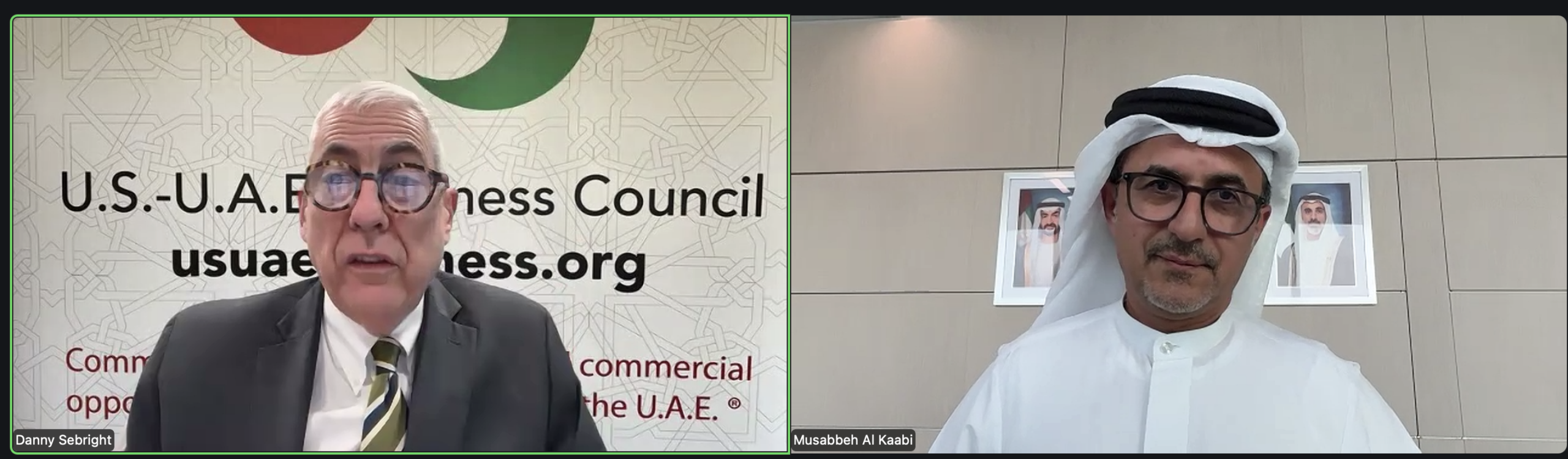
“I have full confidence that the U.A.E. will emerge more resilient and stronger than ever.” Musabbeh Al Kaabi, CEO of ADNOC Upstream.
This statement framed a virtual briefing hosted by the U.S.-U.A.E. Business Council on Thursday, March 26, 2026, featuring Musabbeh Al Kaabi, Chief Executive Officer of ADNOC Upstream. The webinar convened members and partners from the United States and the United Arab Emirates for a focused discussion on energy strategy, market dynamics, and the evolving U.S.-U.A.E. commercial energy relationship amidst the ongoing closure of the Strait of Hormuz.
Mr. Al Kaabi echoed key themes from H.E. Dr. Sultan Al Jaber’s remarks at CERAWeek, particularly the emphasis on resilience, energy security, and the central role of stable markets in underpinning global prosperity. He also highlighted ADNOC’s upstream priorities, its use of AI, and the broader strategic direction of the U.A.E.’s energy sector, including its investment footprint in the United States and the role of its integrated platform, including XRG, across gas, chemicals, and lower-carbon energy solutions.
Impact of Strait of Hormuz Closure:
- Mr. Al Kaabi highlighted the Strait of Hormuz as a critical economic lifeline, noting that approximately 35% of global crude exports and 20% of LNG trade pass through the corridor, as well close to one third of the world’s fertilizers.
- Disruptions to the Strait of Hormuz are acts of economic terrorism that carry immediate and far-reaching consequences for global energy prices, food security, and economic stability, with a particular impact on those who are less well off.
- There is a need for a collective global response to address the closure or weaponization of the Strait of Hormuz.
Infrastructure Resilience and ADNOC Priorities:
- “Invest in Optionality”: ADNOC will double down on expanding alternative export routes and storage infrastructure to reduce reliance on single chokepoints. Far-sighted past investments such as the Habshan–Fujairah pipeline currently provide critical bypass capacity to the Strait of Hormuz, and further diversification remains a priority.
- Regional cooperation: There is a need for strengthening collaboration across neighboring countries to ensure more integrated and resilient energy networks.
- Technology and security: Increasing investment in advanced technologies, including AI-enabled monitoring and defense systems can protect critical infrastructure in an increasingly complex threat environment.
Digitalization and AI in upstream operations:
- ADNOC continues to scale the deployment of artificial intelligence across its operations to enhance efficiency and resilience.
- Mr. Al Kaabi highlighted the company’s NEURON 5 platform, which has significantly improved maintenance planning and reduced shutdown times, in some cases by up to 50%.
- In certain offshore assets, ADNOC has successfully implemented autonomous systems that allow for real-time adjustments to production levels while reducing the need for on-site personnel.
- The U.A.E. as a country ‘means business’ when it comes to AI and plans to be a key player in the AI domain moving forward.
XRG strategy and U.S. opportunities:
XRG’s international investment platform, XRG, plays a central role in advancing the company’s global strategy. With approximately $150 billion in assets under management, XRG is focused on natural gas, chemicals, and lower-carbon energy solutions.
The United States is a key pillar of this strategy:
- ADNOC has committed approximately $80 billion in investments across the United States, spanning energy, chemicals, and renewables.
- The company is already active in 11 U.S. states, supporting job creation and industrial growth.
- Key areas of focus include LNG and gas infrastructure, chemicals manufacturing, and large-scale energy solutions aligned with rising demand from AI and data center expansion.
- The U.A.E. overall has invested over $1 trillion in the United States to date, with another $1.4 trillion new investments in the pipeline over the next 10 years
- The U.S. private sector is ‘second to none’ when it comes to innovation, and the U.A.E. is looking for partners with motivation, shared vision, and who will put “skin in the game.”
To learn more about this event and the U.S.-U.A.E. Business Council’s programming, please contact Matthew Gardell at mgardell@usuaebusiness.org.