“The response from our partners since the start of the conflict has been consistent. Whether in finance, technology, healthcare, or culture, they do not step back. They lean in.” – H.E. Amna Almheiri, U.A.E. Consul General in New York City.
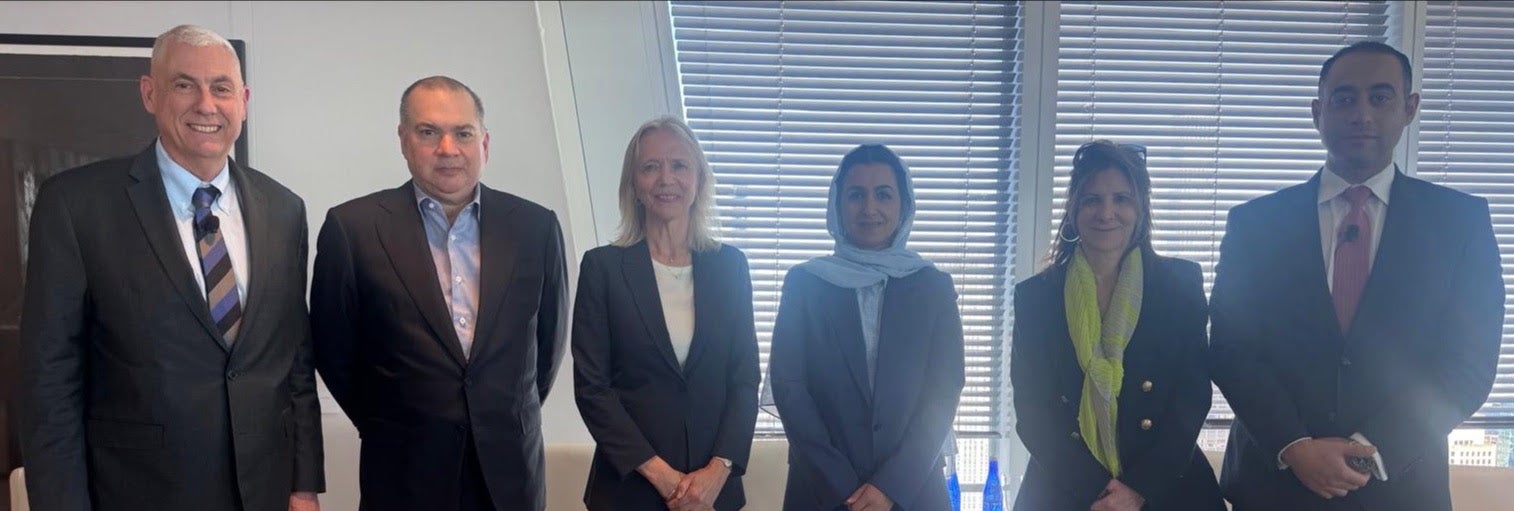
The U.S.-U.A.E. Business Council convened a high-level luncheon discussion on May 12, 2026, in New York City on the resilience, openness, and long-term strength of the U.A.E. economy and the U.S.-U.A.E. trade, investment, and commercial relationship. The off-the-record discussion featured insights from senior leaders across diplomacy, finance, education, and culture, underscoring the U.A.E.’s emergence as a global model for business continuity, tolerance, and economic diversification.
Panelists included:
- H.E. Amna Almheiri, Consul General, Consulate General of the U.A.E. in New York City
- Mariët Westermann, Director and CEO of the Solomon R. Guggenheim Museum and Foundation
- Linda Mills, President, New York University
- Arshad Gharfur, President for the Middle East and North Africa, Bank of America
- Karim Gamal, Executive Director, U.A.E. Embassy Trade and Investment Office
Bottom line:
- Despite heightened regional tensions, the U.A.E. continues to demonstrate economic resilience, institutional stability, and long-term strategic confidence rooted in decades of economic diversification and advanced infrastructure spanning sectors such as financial services, logistics, tourism, healthcare, energy, and artificial intelligence.
- The U.A.E. continues to execute on its landmark $1.4 trillion investment commitment into the U.S. over the next decade, pursuing investments across strategic sectors including AI, advanced manufacturing, healthcare, energy, and digital infrastructure to deepen the bilateral U.S.-U.A.E. strategic partnership.
- As a testament to the growing international confidence in the U.A.E.’s economic leadership, Abu Dhabi has been selected to host the 2029 IMF-World Bank Annual Meetings.
Key Takeaways:
The U.A.E. as a Model
- H.E. Almheiri described the U.A.E. as a model of openness, tolerance, and inclusivity, highlighting the country’s diverse expatriate population and multicultural society as central to this model. She noted that, “The U.A.E. was built to navigate challenges while remaining globally engaged.”
- Linda Mills highlighted that “students from more than 130 countries study at New York University Abu Dhabi (NYUAD)” and emphasized that the institution itself was “built on the principles of coexistence, inclusivity, and global engagement.”
- Mariët Westermann emphasized that the U.A.E.’s investments in arts and culture reflect a broader national strategy centered on tolerance and diversity, pointing to institutions such as the Louvre Abu Dhabi and Abrahamic Family House as international symbols of religious tolerance and intercultural dialogue.
Business Continuity and Resiliency
- H.E. Almheiri emphasized that the U.A.E. leadership demonstrated confidence and resilience throughout the crisis by maintaining an active public presence and continuing official engagements across the country. She also credited the U.A.E. leadership for their foresight by investing in sophisticated defenses, resilient infrastructure, and diversified supply chains.
- Karim Gamal noted that the U.A.E. emerged stronger following both the 2008 global financial crisis and the COVID-19 pandemic and expressed confidence that the U.A.E. will once again emerge stronger from the current regional tensions. Gamal stressed that the U.A.E.’s resilience stems from its highly developed commercial infrastructure and its long-term economic diversification strategy across sectors such as financial services, healthcare, logistics, energy, manufacturing, and advanced technologies.
- Linda Mills reflected on the experience of students and faculty at NYUAD and highlighted that students continued to feel secure and supported because of confidence in the U.A.E. government’s commitment to safety and stability, with many graduates choosing to remain in the U.A.E. after completing their studies.
- Arshad Ghafur noted that, unlike the 2008 global financial crisis, expatriates increasingly view the U.A.E. as a long-term home and demonstrated confidence in remaining in the U.A.E. or quickly returning. While 10-15% of expatriates temporarily departed during the regional attacks, most quickly returned, with Bank of America’s workforce in the U.A.E. fully operational shortly thereafter.
- Ghafur also observed that, unlike during the 2008 financial crisis, financial markets, capital flows, and commercial activity in the U.A.E. continued to function effectively throughout the crisis period, and international financial institutions and capital market firms continued to establish operations in hubs such as Abu Dhabi Global Market (ADGM).
Opportunities for Enhanced Bilateral Engagement
- H.E. Almheiri expressed confidence that “now is the time” to strengthen commercial partnerships and expand bilateral engagement, emphasizing that the U.S.-U.A.E. relationship has evolved into a broad-based strategic partnership centered not only on security cooperation, but increasingly on technology, investment, innovation, education, and people-to-people ties.
- Karim Gamal noted that opportunities for the bilateral relationship have grown out of President Trump’s visit to the U.A.E. in May 2025, highlighting the U.A.E.’s continued pursuit of long-term investment opportunities across all 50 U.S. states, with recent outreach and engagement efforts spanning Kansas, North Carolina, Illinois, Maryland, Oklahoma, Florida, and other states.
- Gamal also highlighted the U.A.E.’s growing investments in the U.S., including sectors such as artificial intelligence and manufacturing, with “major investments in two data centers in Kansas and an aluminum smelter in Oklahoma.”
- Linda Mills emphasized that collaboration between the U.S. and the U.A.E. in areas such as education, innovation, and artificial intelligence will remain critical to building future resilience and preparing students for an AI-driven global economy.
- Mariët Westermann echoed these comments and described “diversity and inclusivity” as “foundational to the U.A.E.’s national identity” and its economic development strategy, as seen through openness to global talent and ideas.
To learn more about the U.S.-U.A.E. bilateral trade and investment relationship, please consult the recent U.S.-U.A.E. Business Council report on the surge in bilateral U.S.-U.A.E. Trade and Investment since President Trump’s U.A.E. visit in May 2025. To learn more about the U.S.-U.A.E. Business Council’s programming and this event, please contact Mr. Adam Karadsheh at akaradsheh@usuaebusiness.org.