“The simplest way I can describe the U.A.E. is that we build strategic infrastructure before the rest of the world agrees that it is urgent.” – Talal Al Kaissi, Chief Executive Officer, Core42
“The way you win the AI race is by having your technology diffused deeply around the world, so that it becomes the incumbent technology everyone uses. The network effects and stickiness that follow are what make it the dominant technology,” argued David Scott.
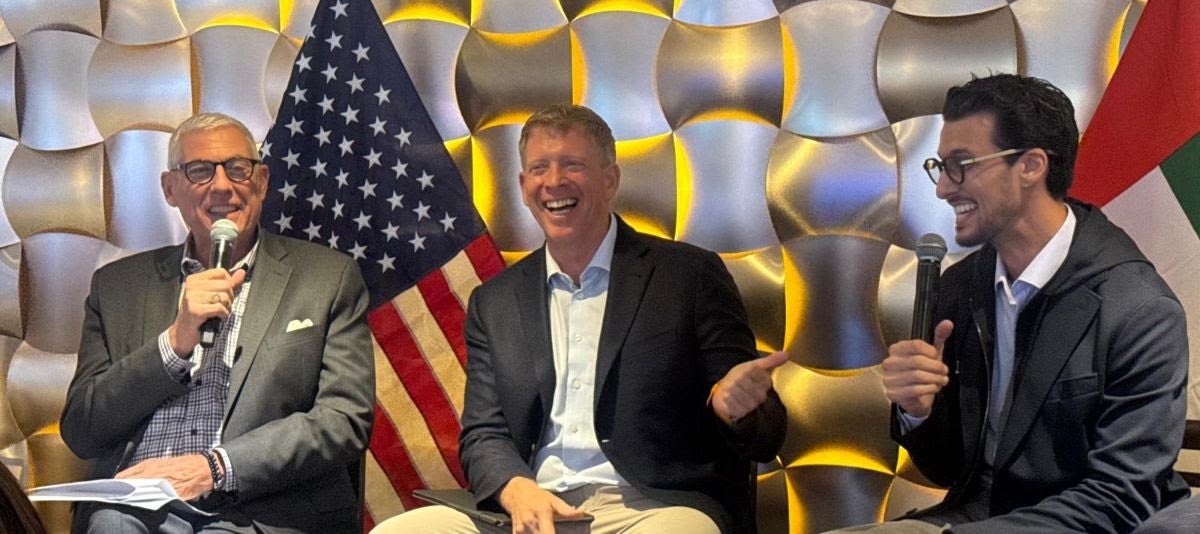
On the margins of U.A.E. Mubadala’s Managing Director and Group CEO, H.E. Khaldoon Al Mubarak’s visit to Washington, D.C., the U.S.-U.A.E. Business Council convened a private dinner conversation on June 1, 2026, in Washington, D.C. Held under Chatham House Rules, the discussion featured Talal Al Kaissi, Chief Executive Officer of Core42 and Acting Group Chief Global Affairs Officer at G42, and David Scott, Chief Strategy and Safety Officer at MGX, and focused on the U.S.-U.A.E. AI Acceleration Partnership, the U.A.E.-U.S. 5GW AI Campus, sovereign cloud, data centers, trusted technology deployment, and strategic investment as increasingly central pillars of U.S.-U.A.E. cooperation. Speakers also provided a scorecard report on the progress of the U.A.E. commitment made during President Trump’s visit to the U.A.E. a year ago to invest $1.4T over the next 10 years in the U.S. market.
Jacob Helberg, U.S. Under Secretary of State for Economic Affairs, also briefed attendees on the progress of Pax Silica and the next steps in the initiative.
Other senior participants included:
- Mark Mitchell, Deputy Assistant Secretary for the Office of the Middle East and Africa at the U.S. Department of Commerce
- Robert Palladino, Senior Bureau Official in the Bureau of Near Eastern Affairs at the U.S. Department of State
- Dane Johnston, Deputy Assistant Secretary for Assistance Coordination and Regional and Multilateral Affairs in the Bureau of Near Eastern Affairs at the U.S. Department of State
- Karim Gamal, Executive Director of the U.A.E. Embassy Trade and Investment Office
- Brian Lott, Chief Communications Officer of Mubadala
The dinner was attended by an intimate group of over 60 U.S. industry and Washington-based think tank representatives.
Bottom line:
- The U.A.E. is moving “full speed ahead” in executing on its AI strategy despite regional tensions… the country has more than doubled down on this commitment.
- The U.A.E.’s AI ambitions reflect a broader national pattern of investing early in strategic infrastructure, from energy and logistics to digital infrastructure and trusted compute.
- The U.A.E. is currently ahead of schedule on the pledge it made last year to invest $1.4 trillion in the United States by 2035. Two weeks ago, the U.S.-U.A.E. Business Council published a report that assesses that the U.A.E. has already invested over $100B in the U.S. in the last year.
Key Takeaways:
AI as the Pillar of the U.S.-U.A.E. Partnership
- Speakers emphasized that AI has emerged as a defining pillar of the bilateral relationship, building on decades of cooperation in energy, defense, trade, and investment. The U.A.E. has made a strategic decision to “bet big on the U.S. AI stack.” That decision shaped the commitments made when the President came to the U.A.E.
- The U.A.E.-U.S. 5GW AI campus was highlighted as a major milestone in the partnership. The effort is part of the U.A.E.’s broader diversification story, and the country is “moving from exporting barrels of oil to exporting tokens and intelligence.”
Building Trusted and Scalable AI Infrastructure
- Speakers stressed that AI is not only a software story. It requires a full ecosystem of power, chips, cloud, data centers, networking, liquid cooling, memory, cybersecurity, and long-term financing. Sufficient memory chips in particular are increasingly a constraint on data center construction.
- Participants noted the enormous capital intensity of AI infrastructure and the growing role of U.A.E. investment platforms in supporting both domestic AI buildout and U.S.-based digital infrastructure. Speakers highlighted that the U.A.E. and its partners have collectively committed to construct 5.7 GW of new compute capacity in the United States, alongside major investments in platforms such as Vantage Data Centers, GlobalFoundries, the AI Infrastructure Partnership, and leading AI companies such as OpenAI.
- Trust and verification were recurring themes. Talal Al Kaissi emphasized that the key operative word is verified and viable trusted control regime which underscores the importance of reliable export controls, cybersecurity, physical security, logical security, and practical compliance mechanisms for the deployment of sensitive technologies.

Resilience and Long-Term Opportunity
- Speakers framed the U.A.E.’s AI strategy as part of a broader approach to resilience, diversification, and early infrastructure planning, pointing to examples such as the Barakah nuclear energy plant, the Fujairah pipeline, railroad, air defense, and sovereign cloud architecture.
- Under Secretary Jacob Helberg previewed priorities for the next Pax Silica meeting, highlighting broad themes including cooperation among forward-leaning economies on AI-related supply chains, semiconductor capacity, and the infrastructure needed to support long-term technological leadership.
- Despite regional tensions, the discussion reflected continued confidence in the U.A.E. as a safe, stable, and resilient platform for long-term investment, technology deployment, and commercial partnership.
- All speakers reinforced statements over recent months by senior U.A.E. government officials including Ambassador Yousef Al Otaiba that the U.A.E. is more committed than ever to its bilateral security, defense, and commercial relationship with the United States.
To learn more about the U.S.-U.A.E. bilateral trade and investment relationship, please consult the U.S.-U.A.E. Business Council’s recent reporting on bilateral trade, investment, and strategic cooperation. To learn more about the U.S.-U.A.E. Business Council’s programming and this event, please contact Mr. Jack Loessberg at jloessberg@usuaebusiness.org