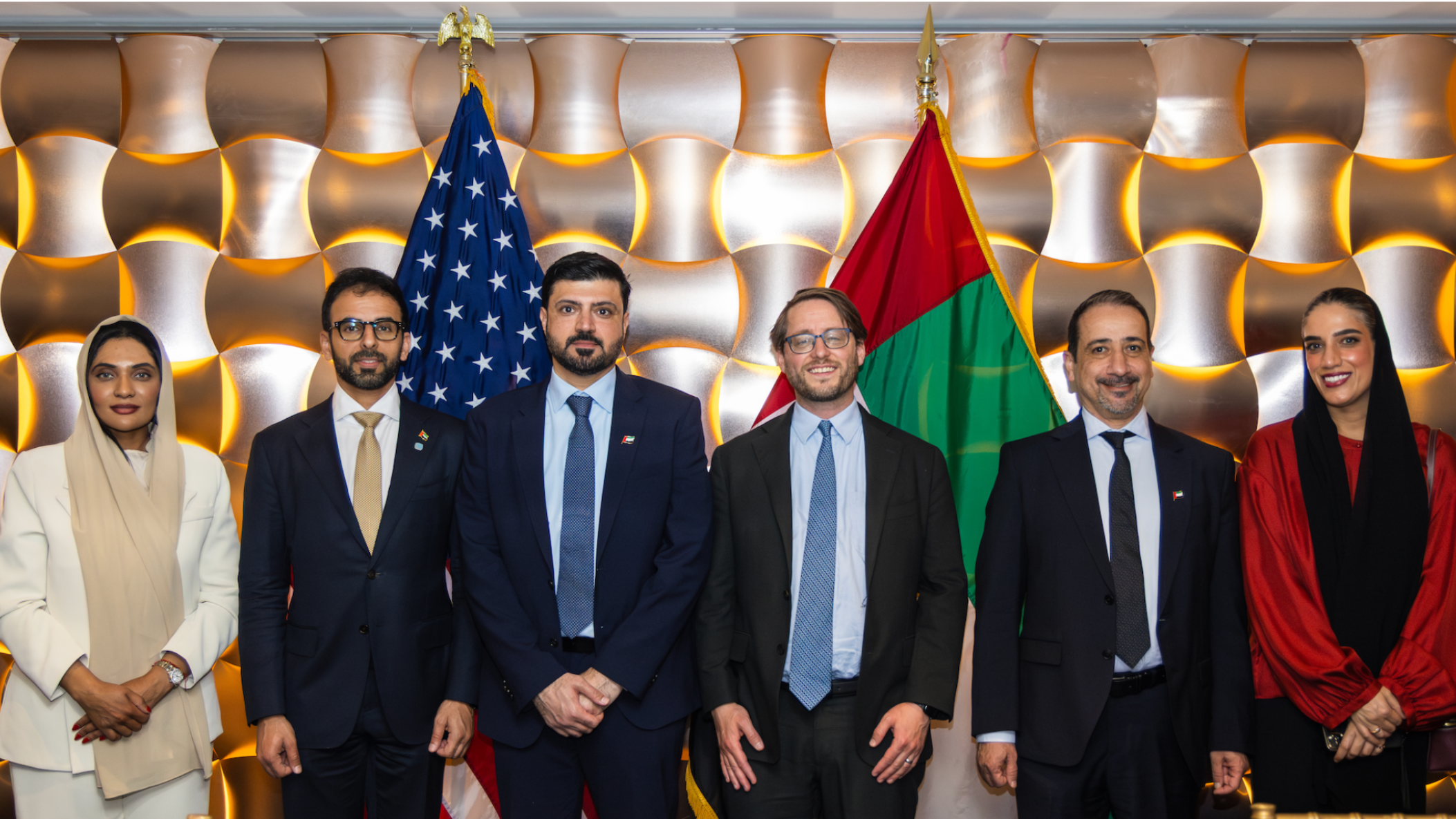
“Safety has been the priority. Citizens, residents, or visitors—all are taken care of equally within the U.A.E. We will emerge stronger, more resilient, and more prepared to weather future crises.” — H.E. Mohamed Bin Taliah
The U.S.-U.A.E. Business Council hosted a private dinner on April 16, 2026 in Washington, D.C. in honor of a senior-level delegation of U.A.E. government officials participating in the 2026 World Bank and IMF Spring Meetings. The off-the-record dinner convened senior U.S. and U.A.E. public- and private-sector stakeholders for a discussion on economic resilience, government reform, and opportunities to deepen bilateral commercial cooperation.
The leader of the Emirati delegation, His Excellency Mohamed Bin Taliah, Assistant Minister of Cabinet Affairs for Government Knowledge Exchange, spoke about the U.A.E. business community’s resiliency in the face of the current conflict and his government’s continued focus on reducing bureaucracy.
Context:
- H.E. Bin Taliah was in Washington, D.C. to sign a Memorandum of Understanding with the World Bank on the Zero Government Bureaucracy Initiative.
- This week, Abu Dhabi was selected to host the 2029 World Bank/IMF Annual Meetings — the first time the U.A.E. will host since 2003.
Key Takeaways:
- Government Innovation Driving Competitiveness: The U.A.E.’s Zero Government Bureaucracy Initiative and broader public sector modernization efforts are enhancing efficiency, reducing friction for businesses, and reinforcing the U.A.E.’s position as a global hub for investment and innovation.
- Resilience in the Face of Crisis: Emirati officials emphasized that safety, continuity, and rapid response have been central to the U.A.E.’s approach amid recent regional tensions. Leaders underscored that the country was well prepared for the crisis and is continually applying lessons learned to further strengthen preparedness and institutional resilience.
- Strong Public-Private Coordination: U.S. private sector participants highlighted the U.A.E. government’s close coordination with companies during the crisis, including rapid support to restore services and protect critical infrastructure such as data centers.
- Confidence from the Private Sector: Representatives from leading U.S. financial institutions and technology firms commended the U.A.E.’s clear communication and decisive response to the crisis, with one noting, “we commend the U.A.E. for stepping up.” Asset managers also reaffirmed their long-term commitment to growing their presence in the U.A.E. and using it as a regional base.
- Momentum in Bilateral Engagement: Participants underscored the continued importance of U.S.–U.A.E. collaboration across finance, technology, and investment, particularly as both countries advance long-term economic transformation agendas.
U.A.E. Commercial Attaché Jawaher Almheiri closed the evening thanking companies who stood in solidarity with the U.A.E. during these challenging times.
She quoted U.A.E. Ambassador Yousef Al Otaiba in saying, “We are open for business.”